
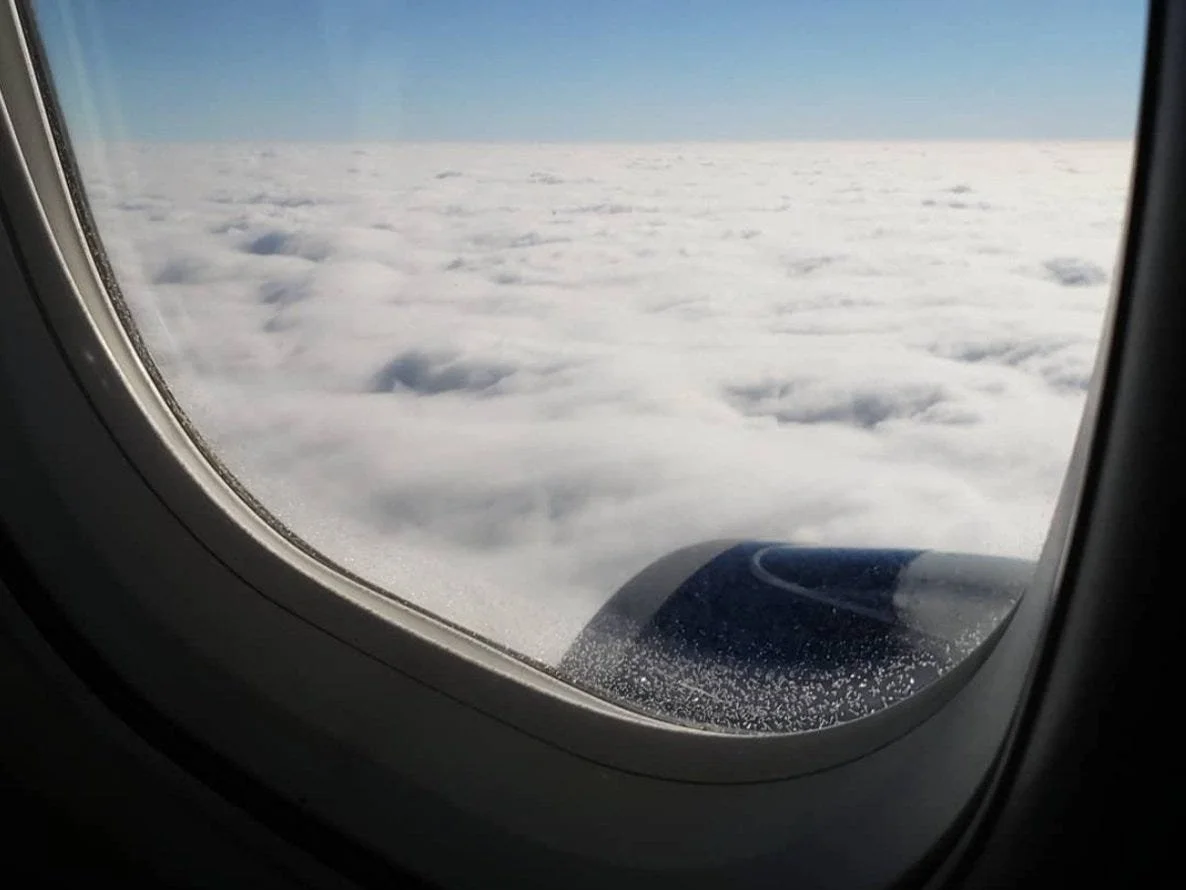
A decade of flying economy has left me with a growing sense of dread. I’m not worried about my journey but rather the impending seat I’ll spend it in.
I am not a tall person. At five feet and one inch, I am an objectively compact traveler. I’m the size of person who airlines should theoretically have no trouble accommodating. Yet, on a recent two-hour flight, I found myself crammed into a window seat so restricted that shifting my weight felt like an act of violence against my neighbor.
If this experience was uncomfortable for me, I can only imagine what it’s like for someone with an average-sized stride.
I’ve been flying economy for most of my life. I’ve crossed oceans in middle seats, slept upright on red-eyes, and mastered the art of eating a full meal with my elbows pinned to my sides. I appreciate how accessible economy flights can be. They’ve made life-changing travel possible for me when I was a broke college student or freelancing full-time.
But the economy cabins I fly today are not the ones I used to fly. Economy today is, in almost every measurable way, bad and getting worse.
The seat pitch has narrowed. The tray table has shrunk. The complimentary food has vanished. And somehow, we’ve all just accepted it.
Along with crappier in-flight experiences, travelers are experiencing delayed take-offs due to weather and hours spent circling destinations due to air traffic congestion. We are missing flights through no fault of our own. During these delays, we just have to sit inside crammed cabins that are either too hot or too cold without getting offered so much as a bag of pretzels.
Thanks for reading Stories By Selvi! Subscribe for free to receive new posts and support my work.
A Case Study in Bare Minimums
Last week, I took a two-hour flight. It was barely enough time to reach a cruising altitude before the descent. Somehow, though the flight time was minimal, the indignities were many.
When I settled in and reached for the seat-back pocket to stow my water bottle, I found a crumbled food container, the ghost of someone else’s journey. It was a small thing, but it was telling. In the race to turn planes around faster and faster, cleaning is no longer necessary.
The tray table, a humble rectangle I rely on to hold my book, cradle my tea, or rest my head against for a nap, was miniature. Not compact-and-clever miniature, but perfunctory. That small plastic flap communicated, wordlessly, that my comfort was a low priority.
We were offered water, juice, or soda for free. If we wanted food, even a snack, we had to pay.
This is now the norm on most flights. Plus, if weather causes you to miss your ride on these glorified Conex boxes, don’t expect a refund.
How We Got Here: The Unraveling of the Flying Experience
This decay did not happen by accident. The story of modern-day economy class is, in large part, the story of systematic removal of basic comforts, which are then repackaged and sold back to us at a premium.
Airlines are, of course, businesses. They operate on thin margins, which are subject to volatile fuel prices, labor costs, and macroeconomic turbulence. The economic pressure they face is real.
We can understand the pressure airlines face while still criticizing the solutions they’ve chosen.
The ancillary fee model has become enormously profitable. Across the globe, airlines collect tens of billions of dollars annually in fees beyond the base fare. They charge us for carry-on bags, for comfortable seats, for mediocre snacks, for WiFi. These fees are not incidental. They are, for many carriers, a core revenue strategy. The base ticket price is kept low to appear competitive. The discomforts baked into that base experience are, in a sense, advertisements for upgrades.
Budget airlines like Spirit or Allegiant pioneered this model. They reduce fares to a skeleton price and charge separately for carry-on bags, seat selection, in-flight entertainment, and food. Legacy airlines like United and Delta have watched the budget airlines poach price-conscious travelers, then followed suit.
The race to the bottom was on.
Airlines don’t prioritize low prices, necessarily, but what that low price actually costs you.
No Legroom, No Snacks, No Problem
Due to this arrangement, we’ve lost the basic dignities of shared space.
As an economy airline passenger, you are no longer promised a clean seat pocket, a tray table large enough to be useful, or a small snack to communicate “We’re glad you’re flying with us”. These details cost relatively little to provide, but the fees associated with accessing these basic comforts are incredibly lucrative for the airline’s shareholders.
The physical space allocated to a human body in economy has also quietly, incrementally shrunk.
Seat pitch, for example, is the distance between your seat and the one in front. In the 1990s, 34 inches was considered standard. Today, many budget carriers offer 28 to 30 inches, and some have reduced it even further, as I’m sure you’ve felt. Beyond seat pitch, airplane seats have gotten more narrow and uncomfortable.
Like I said, I am a petite person, about the height of your average middle schooler, and I cannot get comfortable in economy seats anymore.
Airlines have become extraordinarily good at monetizing our discomfort, simply declining to prevent it unless we pay extra.
The Altitude of Expectations
I have never expected luxury from economy class. All I expect, and what I think most travelers expect, is basic functionality.
I just need a seat that doesn’t make a full-grown adult feel like they’ve been crammed into a child’s carnival ride. I just need a tray table that fits a standard paperback, and a seat pocket that is, at minimum, empty of trash. These are not extravagant requests. They are literally the lowest demands an airline passenger can ask for.
Yet here I am, a decade into flying, watching that floor of expectation descend even further.
My awe of air travel, the miracle of it and how it collapses continental treks into a handful of hours, hasn’t diminished. However, the experience of air travel, for the vast majority of passengers who fly in the back 75% of the plane, has become absolute shit.
Quietly, incrementally, and entirely by design we have been stripped of the bare minimums.
How To Fly Smarter With the Small Power We Have
We can’t widen the seats. We can’t bring back the free food or negotiate away the fee for picking our seats.
The structural forces shaping economy cabins are far out of our control, but we are not entirely powerless. A little strategy goes a long way toward reducing the financial and logistical sting of modern economy flight.
Start before you even book. Rather than searching a single airline’s website and accepting whatever price they present, I use an aggregator like Google Flights or Skyscanner to compare all my options side-by-side.
From there, flexibility is your best friend. I find mid-week departures and comparing alternate airports like Cleveland or Pittsburgh, if that’s doable, can meaningfully reduce what I pay.
If you have the time to monitor prices, watch for the so-called 54-day window, or roughly eight weeks before departure. At this time domestic fares tend to hit their lowest point. I use my Capital One Travel Portal to set a price alert and check in from there.
Airlines sometimes display lower regional pricing depending on where they think you’re browsing from. So try running your airfare searches through a VPN rather that searching straight from Google or Safari.
Budget carriers often have no interline agreements, which means that if your first flight is delayed, they are under no obligation to rebook you on another carrier.
A missed connection can quickly spiral into an expensive overnight stay with no one to help you. Flying direct, whenever possible, is the simplest protection against this risk.
Regardless of which airline you fly, consider travel insurance. Most travel credit cards like these come with complimentary travel insurance at no additional cost. The same carriers charging for snacks tend to have strict cancellation policies, and a modest policy can be the difference between a refund and a forfeited fare when plans change unexpectedly.
The airline won’t advocate for your comfort, but you can safeguard your peace-of-mind by flying informed, booking strategically, and protecting yourself before you ever reach the gate.
None of these tips change the fundamental reality of what economy cabin has become. They do, however, change what modern air travel costs you in money, in stress, and in the unpleasant surprise of finding yourself stranded at a connecting airport with no recourse and a budget carrier’s hold music in your ear.
Enjoyed this post? There's a whole lot more waiting for you!
Subscribe to my Substack for travel inspo, honest essays, ethical travel takes, and real talk about freelancing and finances, all delivered straight to your inbox.
No spam. Just stories.